Start here
The neighbourhood
Bo-Kaap
Share this story ↗
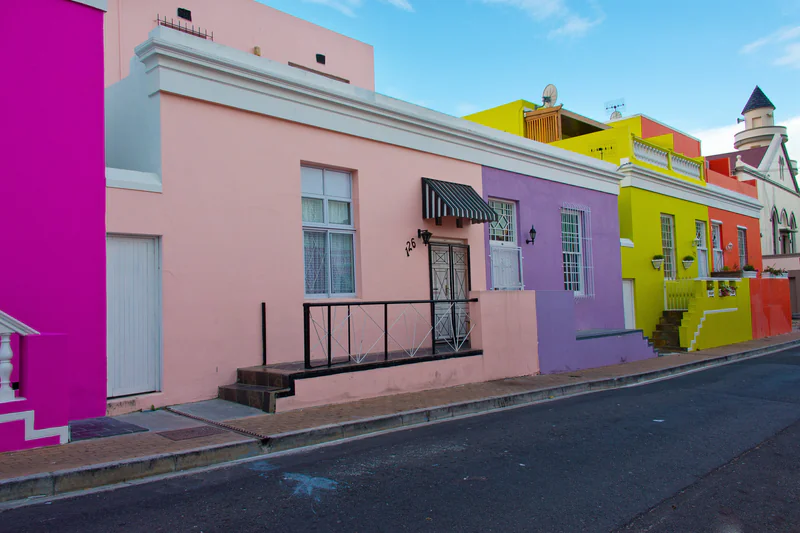
Bo-Kaap is a neighbourhood of narrow, flat-roofed houses on steep cobbled streets above the city centre. The Auwal Masjid on Dorp Street, the Bo-Kaap Museum on Wale Street and the Tana Baru burial ground at the top of Longmarket Street are all here, and people live in the houses between them.
What you are looking at
The houses are narrow and flat-roofed, with stoeps, parapets, sash windows and shutters, in a stepped run down the slope. The South African Heritage Resources Agency describes the townscape as a concentration of pre-1850 buildings with Cape Dutch, Georgian, Victorian and Edwardian layers. Under apartheid the houses had to stay white while leased. The bright colours are a late twentieth century tradition; the story that owners painted their houses to mark ownership is popular telling rather than documented cause. In 2019 nineteen Bo-Kaap sites were declared national heritage sites, among them the Auwal Masjid, Tana Baru and the Bo-Kaap Museum.
How it became the centre of Muslim Cape Town
The Auwal Masjid opened on Dorp Street in 1794, the first mosque in South Africa, on land bought by Coridon van Ceylon, a free Black Muslim. Tuan Guru was its first imam, and his handwritten Qur’an is kept there. After religious freedom was proclaimed in 1804, Tana Baru became the first Muslim burial ground; Tuan Guru, Tuan Sayed Alawie and Abu Bakr Effendi are buried there. When the authorities closed the cemetery in 1886, about 3,000 people carried a child there for burial in defiance. In 1957 apartheid declared Bo-Kaap a Malay group area and removed the families it did not count as Malay.
Visiting
The Auwal Masjid is open around the five daily prayers and runs no formal tours. Cover shoulders and knees, and women cover their hair. Tana Baru is open ground for daylight visits, steep and unshaded, and it is still a place of burial. The Bo-Kaap Museum on Wale Street opens Monday to Saturday and is closed on Sunday; confirm the hours before you go. Book a local guide where you can, support the neighbourhood’s businesses, and ask before photographing people or private spaces. A doorway or stoep is not a public viewing platform. Our own walking tours start at the Auwal Masjid.
From the page to the place
Plan a visit
Bo-Kaap Museum
71 Wale Street, Bo-Kaap
The Bo-Kaap Museum uses a historic house to introduce life in the neighbourhood. It is a useful starting point before walking the surrounding streets because it gives the houses and domestic spaces a social context. The visit rewards attention to ordinary household details, which can tell you as much about a community as a large public monument.
Visiting detailsConfirm access and opening times before setting out.