Start here
Who we are
Who the Cape Muslim community is
Share this story ↗
Muslims have lived at the Cape since the 1650s, brought here as exiles and enslaved people under colonial rule. Their descendants are the Cape Malay community of today, at home in Bo-Kaap, the Southern Suburbs and the Cape Flats. This section follows them from the first arrivals to the present.
Where the community comes from
Muslim exiles and enslaved people reached the Cape from the early 1650s. The Mardyckers from Amboyna, who arrived in 1658, are the first recorded group of free Muslims, and they were barred from public worship. In 1694 Shaykh Yusuf of Makassar landed with 49 companions and was settled at Zandvliet on the Eerste River. His household is described as the first lasting Muslim community at the Cape.
How it took root
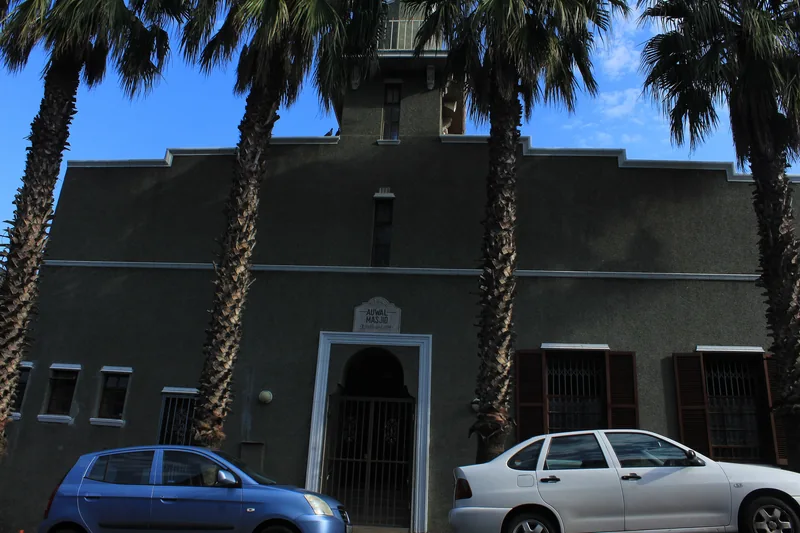
Tuan Guru, a prince of Tidore, was imprisoned on Robben Island from 1780 to 1793 and wrote copies of the Qur’an from memory. In 1794 the Auwal Masjid opened on Dorp Street, the first mosque in South Africa, with Tuan Guru as its first imam. Religious freedom was proclaimed on 25 July 1804, and Tana Baru followed as the first Muslim burial ground. Slavery formally ended on 1 December 1834, with four more years of apprenticeship before real freedom on 1 December 1838.
The community today
On 10 February 1945 sixty-two imams and shaykhs formed the Muslim Judicial Council, one body for the community and a voice against apartheid law. Apartheid then redrew the city: Bo-Kaap was declared a Malay group area in 1957, District Six was declared white in 1966 and more than 60,000 people were removed, and Imam Abdullah Haron died in detention in 1969. The community’s scholarship is written into Afrikaans itself, in Abu Bakr Effendi’s Bayan al-Din of 1877. Bobotie, denningvleis, bredie, koesisters and boeber are its food. On 11 November 2023 tens of thousands marched from District Six to Wale Street for Palestine, and South Africa filed at the International Court of Justice on 29 December that year.
From the page to the place
Plan a visit
Auwal Masjid
39 Dorp Street, Bo-Kaap
Auwal Masjid on Dorp Street is central to the story of Muslim Cape Town. Its early congregation and Tuan Guru’s role as its first imam connect the building with the community’s struggle to sustain worship and learning. His handwritten Qur’an gives that history a surviving object, but the mosque’s continuing life matters just as much as its age.
Visiting detailsConfirm access and opening times before setting out.