In the circle of the tradition · Constantia
Sayed Mahmud
Religious adviser to Matebe Shah, exiled with him in 1668 and buried on the hill in Constantia now called Islam Hill.
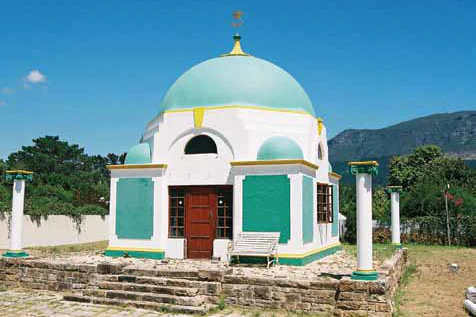
Sayed Mahmud was a spiritual and religious leader from Sumatra and one of the two advisers captured with Sheikh Abdurahman Matebe Shah. With him he was sent into exile at the Cape and to the Company's forest at Constantia.
The inscription on his shrine, taken from the records of the Cape archives, tells the story of their arrival. The ship Polsbroek left Batavia on 24 January 1667 and reached the Cape on 13 May 1668 with three political prisoners in chains, Malays from the west coast of Sumatra. They were to be held until further orders, with care taken that they were never left at large. Two were sent to the Company's forest and one to Robben Island.
The historian Achmat Davids saw in this record the beginning of a policy that lasted through Dutch rule: keeping influential exiles away from the enslaved people of the town, so that their teaching could not spread. It held back the spread of Islam at the Cape.
His shrine stands some distance from the road on the rise in Constantia known as Islam Hill. The walk up the hill is part of the visit.
Sources: Guide to the Kramats of the Western Cape, Cape Mazaar (Kramat) Society (1996; third impression 2010); Government Gazette 45602, 3 December 2021: SAHRA declaration of ten kramats.